🏛️ Architecture
Jibril's architecture represents a fundamental reimagining of how runtime security tools should work. By replacing traditional event streaming with query-driven data retrieval, Jibril eliminates the performance bottlenecks that plague conventional security monitoring.
🎯 The Core Innovation: Query-Driven eBPF
❌ Traditional Approach: Ring Buffers
Traditional security tools push events from kernel to userspace through ring buffers:
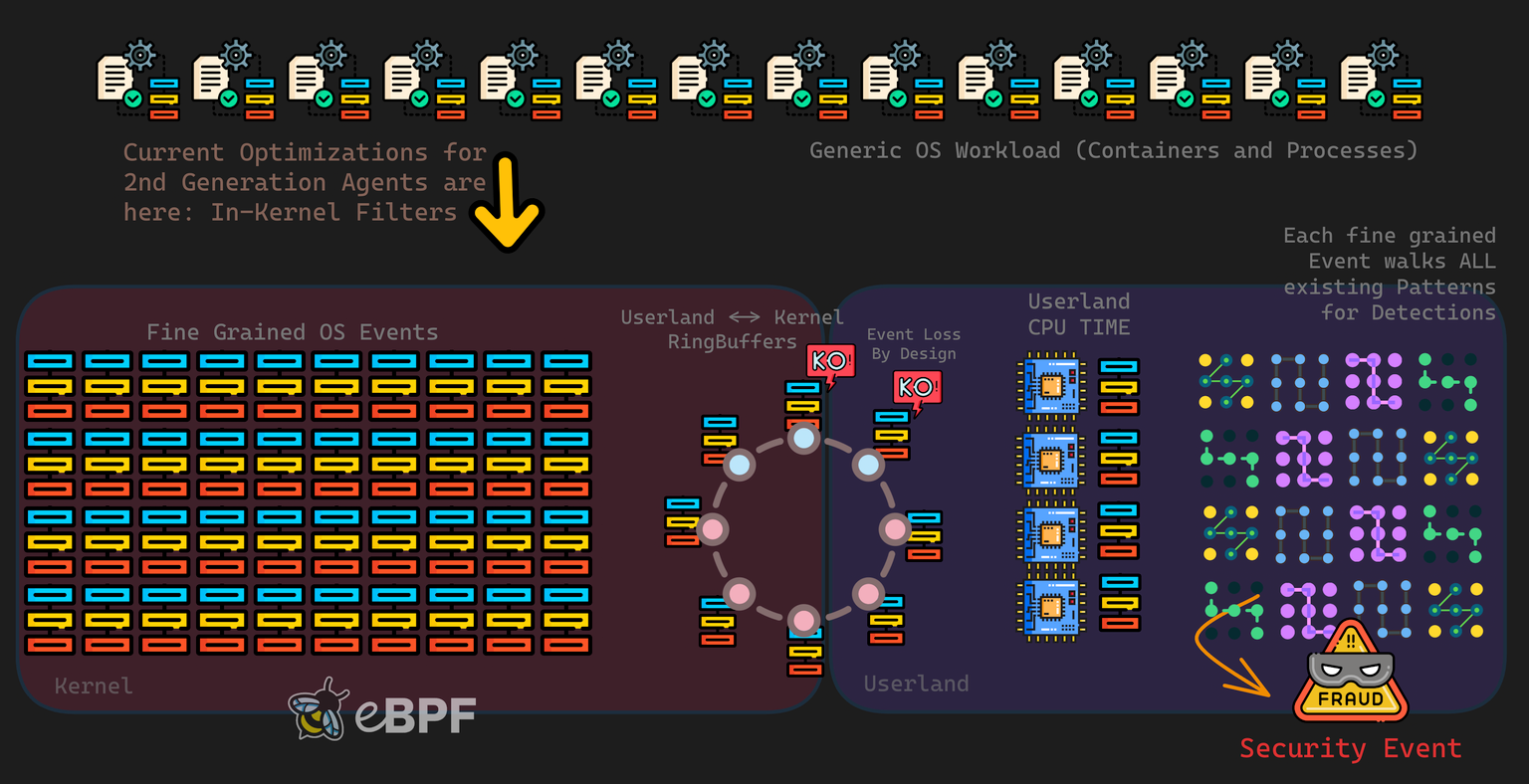
⚠️ Problems with this approach:
- 💥 Ring buffers overflow during high-event scenarios
- 📈 CPU usage spikes exponentially under load
- 🔀 Memory consumption becomes unpredictable
- ❗ Critical events get dropped when you need them most
✅ Jibril's Query-Driven Approach
Jibril's revolutionary approach stores events in kernel maps and retrieves them on demand:
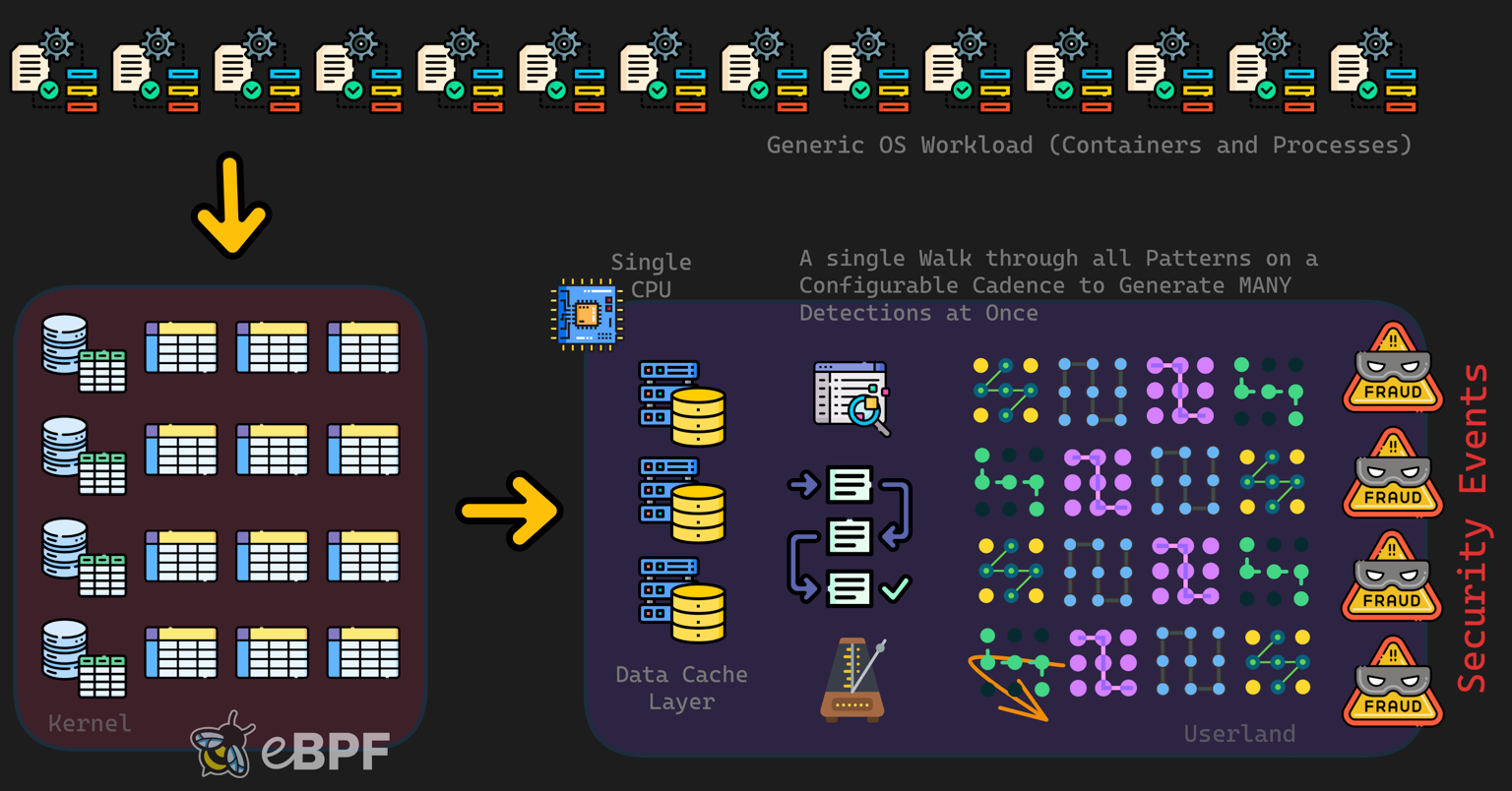
🌟 Advantages:
- ✅ Zero event loss - maps don't overflow
- ⚡ Constant overhead - CPU usage stays flat
- 📊 Bounded memory - configurable, predictable usage
- 🚀 Better performance at scale - higher loads improve caching
💡 Learn more about eBPF maps: eBPF Map Types
🏗️ System Architecture
Jibril consists of three main layers working together seamlessly:
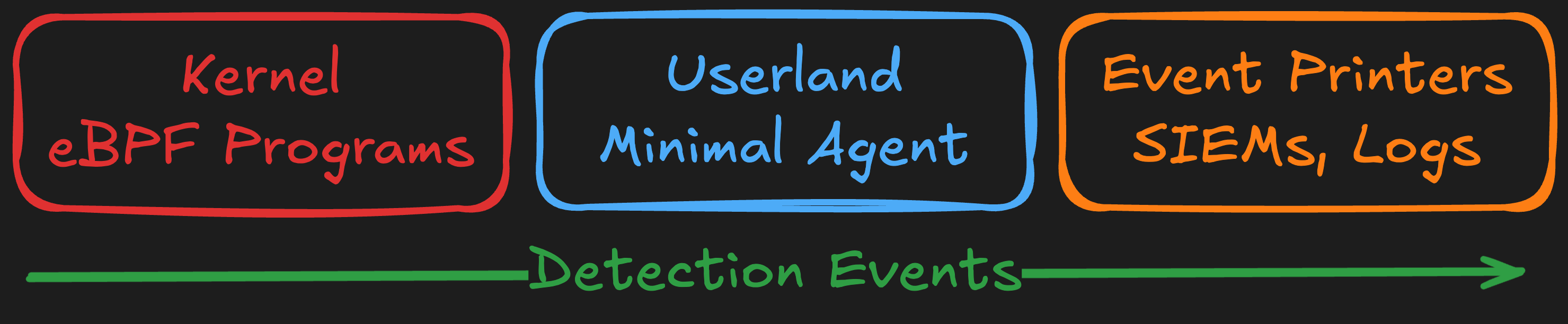
1️⃣ Kernel Space (eBPF Programs)
📡 Event Capture
eBPF programs attach to kernel hooks and capture system events in real-time:
- ⚙️ Process execution and lifecycle
- 📁 File access and modifications
- 🌐 Network connections and communication
- 📦 Container operations
- 🔐 Security-relevant system calls
💾 In-Kernel Storage
Events are stored in high-performance eBPF maps:
- 🗃️ Hash maps for event metadata and context
- 📊 Array maps for configuration and counters
- ♻️ LRU maps for automatic memory management
- 🔒 Cryptographic hashing ensures data integrity
🔄 Uniform Execution
eBPF programs run consistently across all kernel versions without modules or recompilation (thanks to CO-RE).
2️⃣ Userspace Daemon
🔍 Query Engine
The daemon periodically queries kernel maps to retrieve relevant events:
- 🎯 Selective data retrieval reduces overhead
- 📦 Batch processing optimizes performance
- ⏱️ Configurable query intervals balance latency and efficiency
🛡️ Detection Engine
Retrieved events are analyzed against detection rules:
- 🔎 Pattern matching identifies suspicious behavior
- 🧠 Contextual analysis reduces false positives
- 📈 Real-time threat scoring prioritizes alerts
🧩 Plugin System
Modular architecture organizes detection logic by event type:
- ⚙️ Execution plugins - Process and binary monitoring
- 📁 File access plugins - Filesystem operation tracking
- 🌐 Network plugins - Connection and traffic analysis
- 🔗 Thread-based isolation ensures stability and performance
3️⃣ Output Layer (Printers)
🚀 Flexible Routing
Events can be sent to multiple destinations simultaneously:
- 💻 Standard output (stdout) for debugging
- 📝 Log files for persistence
- 🔍 SIEM platforms for centralized monitoring
- 🔌 Custom APIs for integration
- 📊 Dashboards for visualization
🔐 Secure Transmission
All external communication uses authenticated HTTPS with API tokens.
👁️ What Jibril Monitors
Jibril provides comprehensive visibility into all system resources and operations.
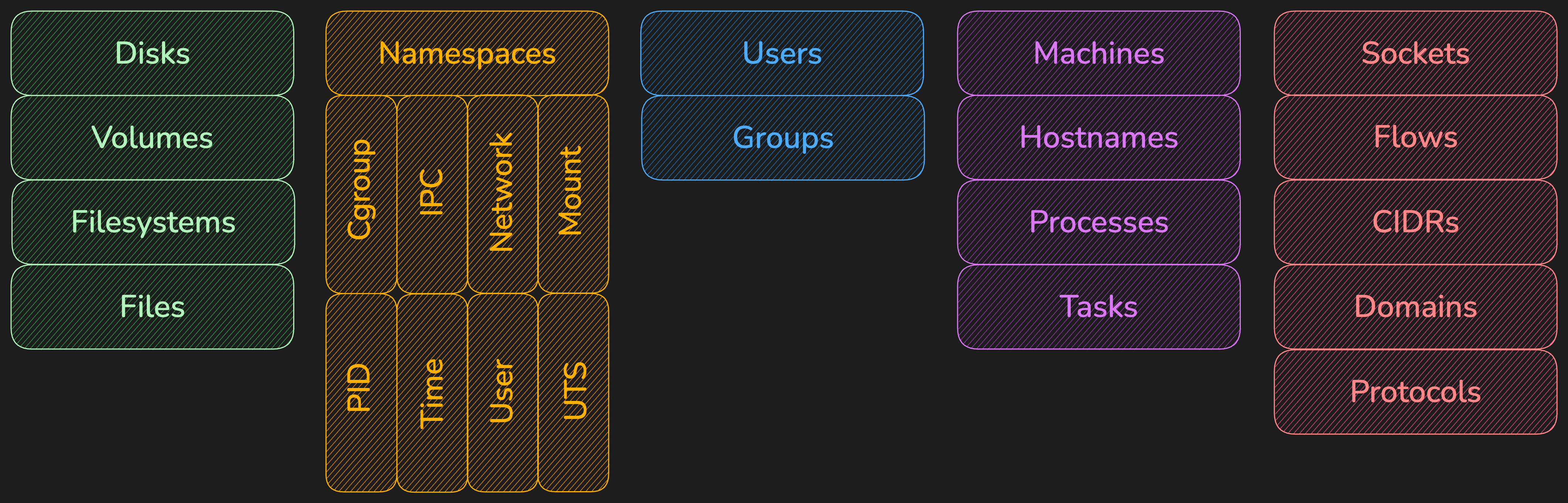
📊 Resources Tracked
👤 Identity & Access
- 👥 Users and groups
- 🔑 Permissions and capabilities
- 🔐 Authentication events
🖥️ Infrastructure
- 💻 Physical and virtual machines
- 📦 Container hosts and nodes
- 🏷️ Hostnames and namespaces
💾 Storage
- 💿 Disks and filesystems
- 📂 Volumes and mount points
- 📄 Files and directories
- 🔗 Symbolic links
⚙️ Execution Context
- 📦 Containers and pods
- 🔄 Processes and threads
- 📋 Binary executables
- 📚 Shared libraries
- 🐍 Interpreters
🌐 Network
- 📡 Network protocols
- 🌍 Domain names and DNS
- 🔌 Ports and sockets
- 🌐 IP addresses
- 🔄 Network flows and peers
🎬 Actions Monitored
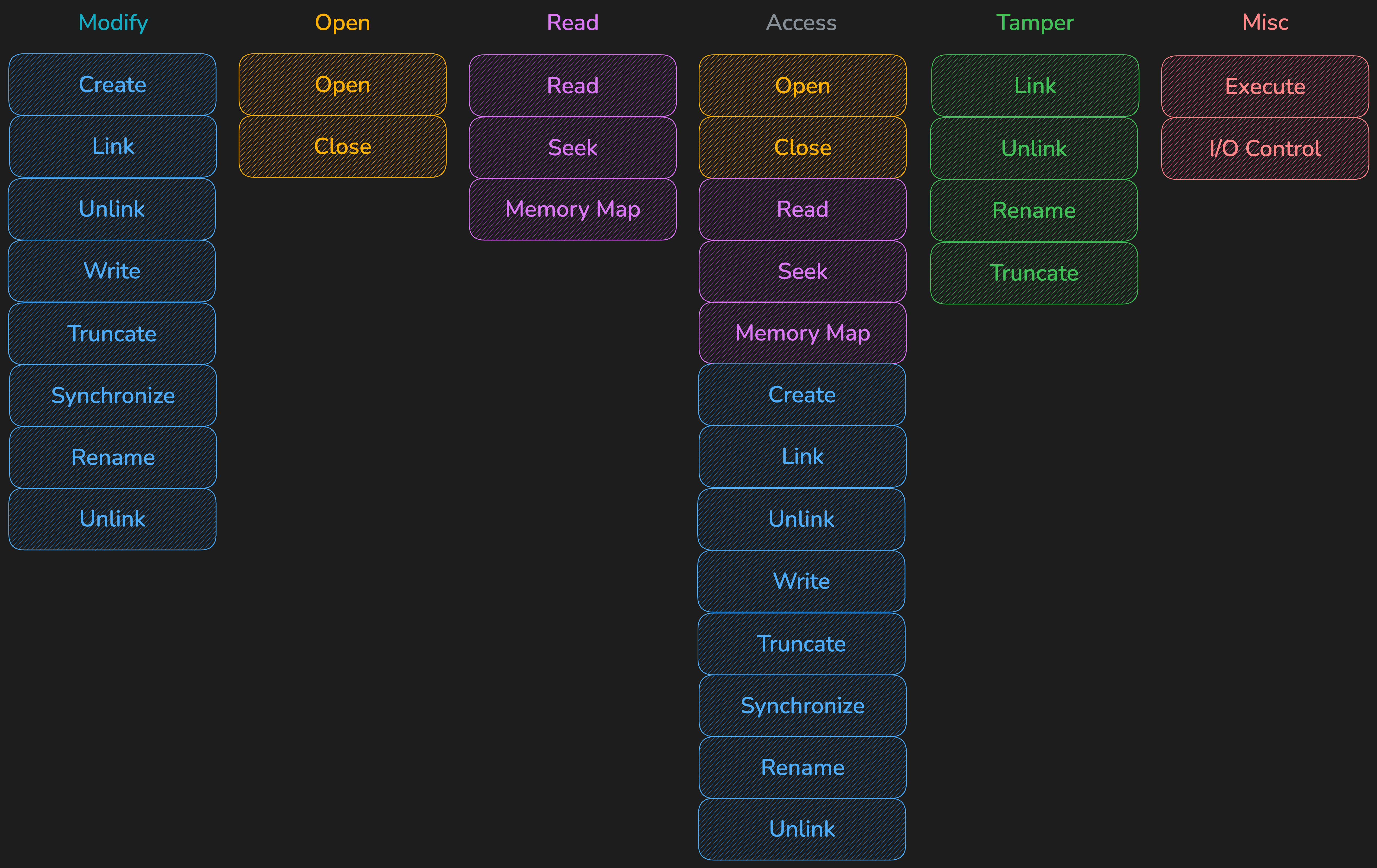
🔄 Lifecycle Events
- ➕ Create, destroy
- ▶️ Start, stop, restart
- 🔀 Fork, clone, exit
✏️ Modifications
- ✂️ Truncate, link, rename
- 📂 Open, close
- 🗂️ Mount, unmount
- 🏷️ Attribute changes
📝 Data Operations
- 📖 Read, write, seek
- ▶️ Execute
- 📋 Copy, move
🔧 Advanced Operations
- 🗺️ Memory mapping
- 🔄 Synchronization
- 🔒 Locking and unlocking
- 🎚️ Capability modifications
🔄 Execution Flow
Jibril follows a structured initialization and execution sequence:
🚀 Startup Sequence
- 🔧 Initialization - Core libraries and system checks
- 🐝 eBPF and Caches - eBPF programs loading and caches setup
- 🧩 Components - Components initialization
- 🔌 Features - Features initialization (Netpolicy, Alchemies, Detect, etc.)
- 📤 Printers - Printers initialization (Stdout, Varlog, etc.)
- 🔄 Main Loop - Main loop execution
All components follow: Init → Start → Execute → Finish → Exit in an hiearchy of components.
⚡ Runtime Operation
- 📡 Event Capture - eBPF programs capture system events in kernel space
- 💾 Storage - Events stored in eBPF maps with metadata and context
- 🔍 Query - Daemon queries maps at configured intervals
- 🛡️ Detection - Retrieved events analyzed against detection rules
- 🎯 Action - Matching events trigger alerts or reactions
- 📤 Output - Results sent to configured destinations
🔒 Data Immutability
Once captured, event data is immutable:
- ✅ Ensures forensic integrity
- 🛡️ Prevents tampering
- 📋 Creates trustworthy audit trails
- 🔍 Enables reliable investigation
⚡ Performance Characteristics
- A pre-defined cadence stipulates deterministic CPU behavior. CPU consumption is reduced with higher cadence values.

- Minimal CPU consumption can be obtained controlling cache size and cadence values. There is no security event processing loss.

📊 Deterministic Resource Usage
💻 CPU Consumption
- 📉 Constant overhead regardless of event volume
- ⚡ Typically less than 2% CPU even at 100,000+ events/second
- 🎯 No performance spikes during attacks or high activity
💾 Memory Usage
- 📦 Bounded, configurable memory footprint
- 📏 Predictable allocation based on map sizes
- ♻️ Automatic LRU eviction prevents unbounded growth
⏱️ Latency
- 🚀 Sub-second query response times
- ⚡ Immediate threat detection
- 👁️ Real-time event visibility
📈 Scaling Behavior
Traditional tools degrade under load. Jibril improves:
- 🎯 Higher event volumes create better cache hit ratios
- 📦 Batch processing becomes more efficient
- 🔄 Query-driven model naturally handles bursts
- ⚡ Kernel-space storage eliminates context-switching overhead
🚀 Jibril has been designed and tested on high workload environments.
🔐 Security Model
🛡️ Tamper-Proof Operation
🔒 Kernel-Level Enforcement
- 🚫 Cannot be bypassed from userspace
- 👑 Root processes cannot evade detection
- 📦 Container escapes are visible
✅ Verified Execution
- 🔍 eBPF verifier guarantees program safety
- 💚 No kernel crashes possible
- 🏖️ Sandboxed execution environment
📚 Learn more about eBPF security: eBPF Verifier
👁️ Comprehensive Coverage
🎯 No Blind Spots
- 🌐 System-wide monitoring
- 👀 All processes visible
- 📋 Complete event capture
- 🔍 Full context for every action
🛡️ Defense in Depth
- 🔄 Multiple detection mechanisms
- 🏗️ Layered security checks
- ♻️ Redundant event capture
🎨 Extensibility
🔧 Custom Detections
Jibril supports custom detection rules for organization-specific threats:
- 🔍 Pattern matching on events
- 🧠 Contextual analysis
- 🔗 Multi-event correlation
- 📊 Threat scoring
📖 Learn more: Customization
🤖 Reaction Engine
Automatically respond to detected threats with JavaScript-based reactions:
- 🚫 Block malicious processes
- 📦 Isolate compromised containers
- 📢 Alert security teams
- 🔧 Trigger automated remediation
⚡ Learn more: Reactions
🔌 Integration Points
Seamlessly integrate with existing security infrastructure:
- 🔍 SIEM platforms (Splunk, Elastic, etc.)
- 📢 Alert management (PagerDuty, Slack, etc.)
- 🎫 Ticketing systems (Jira, ServiceNow, etc.)
- 🔗 Custom APIs and webhooks
🚀 Deployment Modes
📦 Standalone
Single binary with no dependencies:
- ✅ Simple installation
- ⚙️ Minimal configuration
- 🚀 Quick deployment
- 🔄 Easy updates
⚙️ System Service
Run as a systemd service:
- 🔄 Automatic startup
- 👁️ Process supervision
- 📝 Log management
- 📊 Resource limits
🐳 Container
Deploy in containerized environments:
- 🐳 Docker container
- ☸️ Kubernetes DaemonSet
- ⎈ Helm chart
- 🔄 GitOps ready
⚙️ Configuration
Jibril uses a simple YAML configuration file:
cadences:
  file-access: 3 # File access cadence
  network-peers: 3 # Network peers cadence
  network-flows: 3 # Network flows cadence
  env-vars: 3 # Environment variables cadence

caches:
  rec-tasks: 32 # * 1k of recent tasks
  tasks: 64 # * 1k of tasks
  cmds: 32 # * 1k of commands
  args: 32 # * 1k of arguments
  files: 32 # * 1k of files
  dirs: 16 # * 1k of directories
  bases: 32 # * 1k of bases
  task-file: 32 # * 1k of task-file mapping
  file-task: 32 # * 1k of file-task mapping
  task-ref: 32 # * 1k of task-ref tracking
  flows: 32 # * 1k of network flows
  task-flow: 32 # * 1k of task-flow mapping
  flow-task: 32 # * 1k of flow-task mapping
  flow-ref: 32 # * 1k of flow-ref tracking
📖 Learn more: Configuration File
⚖️ Comparison with Traditional Architectures
| Aspect | ❌ Traditional Streaming | ✅ Jibril Query-Driven |
|---|---|---|
| 📊 Data Flow | Push (ring buffers) | Pull (on-demand) |
| 💾 Memory | Unpredictable | Bounded & configurable |
| 💻 CPU Overhead | Increases with load | Constant |
| 📉 Event Loss | Common under stress | Impossible by design |
| ⏱️ Latency | Variable, degrades | Consistent sub-second |
| 📈 Scalability | Decreases with load | Increases with load |